First visit? Route access and timing
details should be confirmed before travel
Today: Seasonal Open • Peak:
Trek/weather dependent
Jyotirlinga No. 5
Kedarnath Jyotirlinga Temple
Himalayan region of Uttarakhand near the source of the Mandakini River
Deity: Lord Shiva as Kedarnath Jyotirlinga
Kedarnath Jyotirlinga Temple is revered as Jyotirlinga No. 5, the
fifth among the 12 Jyotirlingas, and stands in the Himalayan
region of Uttarakhand near the source of the Mandakini River.
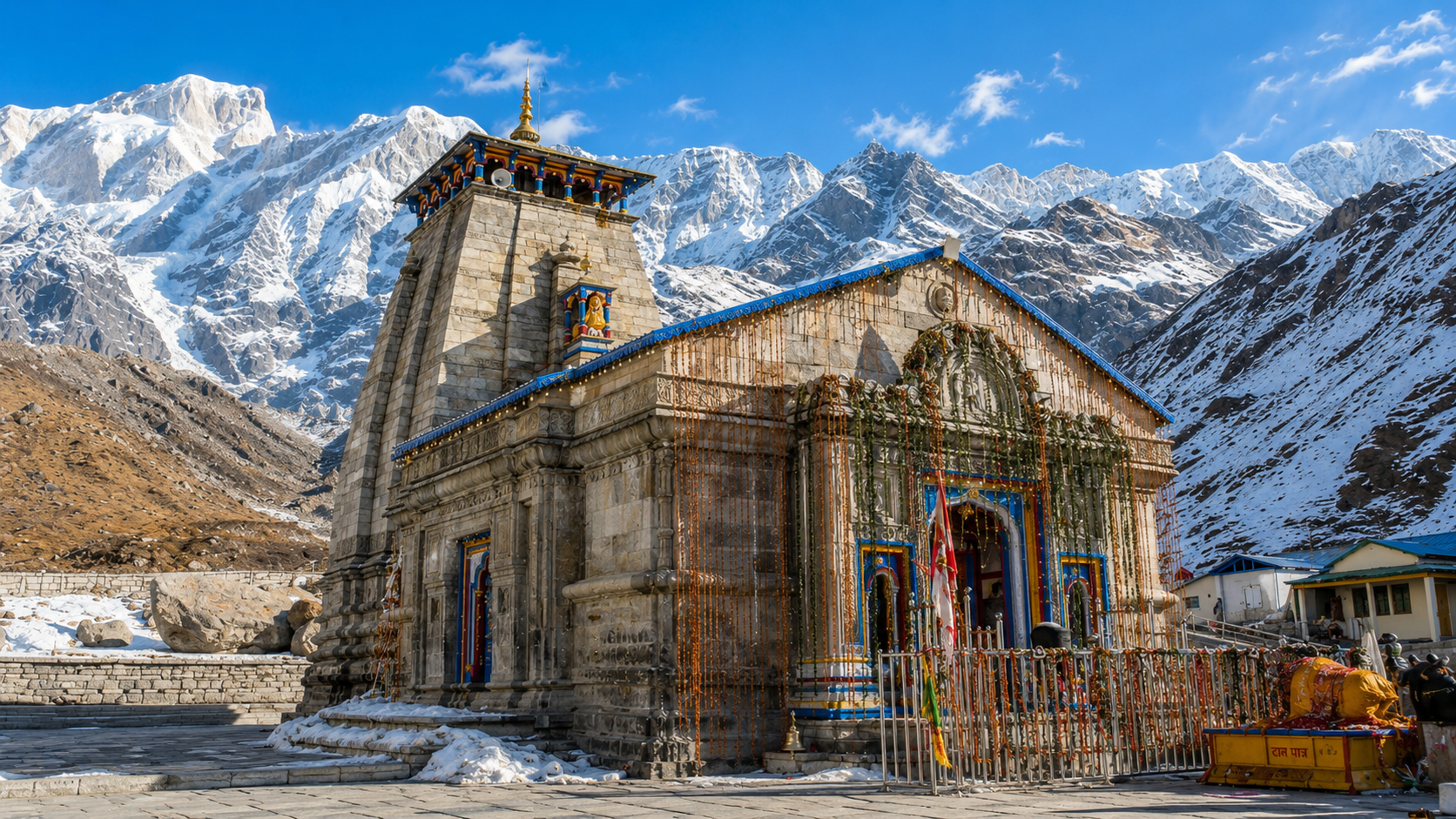
Standing at about 3,583 meters and surrounded by snow-covered
mountains and natural beauty, Kedarnath is an important part of
both the Char Dham and Panch Kedar pilgrimages and is known for
ancient stone architecture, extreme weather conditions, spiritual
atmosphere, and a strong Mahabharata connection.
Seasonal access, weather and route conditions should be verified
before planning Kedarnath darshan.
Meaning of Kedarnath
Lord of the Sacred Kedar Region
Kedar means field or powerful
spiritual place, Nath means Lord, and Kedarnath means Lord of
the Sacred Kedar Region.
Kedar = Sacred FieldNath = LordSacred Kedar Region
Temple Status
Seasonal Open
Please confirm current darshan and route status before travel.
Crowd Expectation
Trek & weather dependent
Crowd guidance depends on route and season.
Queue flow changes with weather and yatra movement.
Next Aarti
Check Yatra Schedule
Check yatra status and official puja counter schedule
Best Darshan Window
Timings Not Verified
Preferred darshan window changes with weather and route flow.
Recommended
Trek, weather and access coordination details should be
verified before travel.
Today: Check yatra and route conditions before travel.
Map
Map
Temple Location Snapshot
Himalayan region of Uttarakhand near the source of the Mandakini River
Understanding the spiritual importance of Kedarnath
Jyotirlinga
No. 5 and fifth among the 12 Jyotirlingas of Lord
Shiva
Located in the Himalayan
region of Uttarakhand near the source of the Mandakini
River
Important part of both the
Char Dham and Panch Kedar pilgrimages
One
of the most sacred Himalayan Shiva temples with a strong
Mahabharata connection
Connected
with ancient stone architecture, extreme weather, and a
mainly south-facing shrine identity
Kedarnath is one of the most sacred temples of Lord Shiva and is
the fifth among the 12 Jyotirlingas. It stands in the Himalayan
region of Uttarakhand near the source of the Mandakini River at an
altitude of about 3,583 meters, surrounded by snow-covered
mountains and natural beauty.
Kedarnath is associated with Char Dham, Panch Kedar, Mahabharata
tradition, ancient stone architecture, extreme weather, and a
powerful Himalayan spiritual atmosphere. The temple mainly faces
south.
Kedarnath unites Himalayan Shiva
devotion, purification, endurance, and the sacred rhythm of Char
Dham and Panch Kedar pilgrimage.
Kedarnath’s sacred origin is deeply tied
to the Mahabharata, the repentance of the Pandavas, and Lord Shiva’s
hidden presence in the Himalayas.
According to the Mahabharata, after
the Kurukshetra war the Pandavas sought Shiva’s forgiveness, but he
hid as a bull in the Himalayas and left his hump at Kedarnath, where it
became worshipped as the sacred Jyotirlinga.
Sacred legend
According to the Mahabharata, after the Kurukshetra war,
the Pandavas sought forgiveness from Lord Shiva for the
sins of war. Shiva avoided them and took the form of a bull
to hide in the Himalayas.
When the Pandavas recognized him, Shiva disappeared into
the ground. The hump of the bull remained at Kedarnath and
became worshipped as the Kedarnath Jyotirlinga. Other body
parts of Shiva appeared at different places, which later
became the sacred Panch Kedar temples.
Mahabharata link
Shiva in bull form
The legend preserves Kedarnath’s sacred memory of
Shiva hiding from the Pandavas in the Himalayas.
Panch Kedar origin
Hump at Kedarnath
The hump remained at Kedarnath, while other sacred body
parts appeared at the other Panch Kedar sites.
Temple History
Kedarnath is believed to have originally been
built by the Pandavas and later revived by Adi Shankaracharya in the 8th
century. It has remained an important center of Shaivism, Himalayan
pilgrimage, and spiritual meditation for centuries.
Despite floods and harsh Himalayan
conditions, Kedarnath has survived for generations and symbolizes faith,
endurance, and Shiva’s divine protection.
Sacred timeline
Kedarnath Jyotirlinga Temple is believed to have
originally been built by the Pandavas and later revived by
Adi Shankaracharya in the 8th century. The shrine has long
held an important place in Himalayan Shaivism, pilgrimage,
and spiritual meditation.
Despite floods and harsh Himalayan conditions, Kedarnath
has survived for generations. The temple stands as a symbol
of faith, endurance, and divine protection while
preserving continuous devotion in one of India’s most
sacred mountain pilgrimage centers.
Ancient tradition
Pandavas and early shrine memory
Kedarnath preserves a longstanding sacred association with
the Pandavas and the Mahabharata tradition.
Revival
Adi Shankaracharya in the 8th century
The temple tradition honors Adi Shankaracharya’s role
in reviving Kedarnath worship.
Endurance
Floods and harsh Himalayan survival
The shrine remains a symbol of divine protection through
difficult mountain conditions and floods.
Temple Architecture & Design
Kedarnath reflects ancient Himalayan stone
architecture through massive grey stone slabs, a powerful mountain shrine
profile, and construction shaped to survive extreme weather conditions in
the high Himalayas.
The temple is known for its
pyramid-shaped shikhara, thick stone walls, large mandapa and sanctum,
Nandi statue facing the entrance, and strong stone construction associated
with survival through the 2013 floods.
Sacred design
Kedarnath is built in ancient Himalayan stone architecture
using massive grey stone slabs, thick walls, and a strong
mountain-temple layout meant to endure severe weather. The
temple includes a large mandapa, a sacred sanctum, and a
pyramid-shaped tower or shikhara rising above the shrine.
The temple entrance is traditionally accompanied by a
Nandi statue facing the shrine. Kedarnath’s strong
stone construction is especially remembered in connection
with its survival through the devastating 2013 floods,
reinforcing the temple’s image of sacred endurance.
Architecture style
Ancient Himalayan stone architecture
The shrine reflects durable mountain design and a long
stone-temple tradition.
Stone construction
Grey slabs and thick walls
The powerful outer shell is associated with survival
through extreme Himalayan weather.
Sacred layout
Pyramid shikhara, mandapa and sanctum
The temple form combines a strong shrine core with a
distinct mountain silhouette.
Endurance
Remembered after the 2013 floods
Kedarnath’s stone construction is strongly associated
with survival through devastating conditions.
Spiritual Importance, Panch Kedar &
Sacred Features
Kedarnath is revered for liberation-seeking
Shiva worship, difficult Himalayan pilgrimage, Panch Kedar importance, Char
Dham identity, and a spiritual atmosphere shaped by snow peaks, rivers,
silence, and devotion.
Worship at Kedarnath is believed to
help remove past sins and guide devotees toward purification, endurance,
faith, sacrifice, and Shiva’s divine protection.
Sacred devotion
Worship at Kedarnath is believed to help devotees attain
liberation and remove past sins. Pilgrims undertake
difficult mountain journeys as an act of devotion and
spiritual purification, and the temple symbolizes
endurance, faith, sacrifice, and Shiva’s divine
protection.
Kedarnath is regarded as one of the most sacred temples of
Lord Shiva and one of the highest Jyotirlingas in the
Himalayas. It is an important part of both the Char Dham
and Panch Kedar pilgrimages, and the Adi Shankaracharya
Samadhi near the temple strengthens its spiritual identity
in the Himalayan region.
Kedarnath Temple is considered the most important and
holiest among the Panch Kedar temples. The shrine is also
remembered for its Himalayan spiritual atmosphere of snow
mountains, glaciers, rivers, silence, ancient stone
architecture, and sacred survival through harsh
conditions. Kedarnath remains a major Himalayan Shiva
pilgrimage destination. Exact ritual and festival schedules
should be verified seasonally.
One of
the highest Jyotirlingas in the Himalayas
Pandava and Mahabharata
connection
Panch
Kedar importance
Char
Dham pilgrimage identity
Adi
Shankaracharya Samadhi near the temple
Snow
mountains, glaciers, rivers, and silence
Ancient
stone architecture and survival through harsh conditions
Panch Kedar temples
Kedarnath Temple
Tungnath Temple
Rudranath Temple
Madhyamaheshwar Temple
Kalpeshwar Temple
Major pilgrimage
Char Dham and Panch Kedar
Kedarnath stands at the heart of both pilgrimage traditions
and remains a major Himalayan Shiva yatra destination.
Spiritual goal
Liberation and purification
Devotees pray for removal of past sins, inner strength,
peace, and Shiva’s protection.
Himalayan sacredness
Samadhi, mountains, rivers and silence
The temple precinct and surrounding landscape deepen the
sense of meditation, endurance, and divine presence.
Darshan Process
A quick visual flow from entry point to
exit.
Average total time: To be
verified
Verify Before Visit
1
Reach Temple Area
Use the approved drop
point and move toward the yatra base, registration flow
and final temple route.
2
Clear Security
Phones, bags and
restricted items are checked before entry.
3
Join Queue Lane
Enter the assigned lane
and keep darshan items ready in hand.
4
Move Final Stretch
The last approach is
controlled in batches near the shrine.
5
Take Darshan
Darshan is brief, so
move calmly and follow temple volunteers.
6
Follow Exit Flow
Continue through the
managed exit toward the temple precinct, rest path or your
return trek / heli coordination point.
Regular buses, taxis and private transfers from nearby cities
Kedarnath is commonly reached through Haridwar, Rishikesh and the mountain road
network leading toward Gaurikund.
2
Step 2
Local Transfer
From your arrival point, continue by road through the active yatra route toward
Sonprayag and Gaurikund.
Taxi / Shared Cab
Haridwar, Rishikesh, Dehradun, Guptkashi and Sonprayag connections
Useful for moving between rail or air bases and the yatra road route
Route Control
Sonprayag transfer points and local movement control
Follow managed shuttle, queue and local authority instructions
Registration
Check yatra registration and travel advisories before the final move
Confirm current rules before proceeding toward Gaurikund
Travel Window
Seasonal route window
Keep buffer time because the mountain route can slow significantly
Final route access details should be confirmed before travel.
3
Step 3
Final Temple Access
Final access details should be confirmed before travel.
Temple Approach
Seasonal road + trek access
Access rules can change with security arrangements and weather
Security Check
Confirm before travel
Before entry
Walking Distance
Route and fitness dependent
Route conditions, pace and stops vary by weather, fitness, crowd and yatra
management
Shuttle / Assistance
Confirm before travel
Availability must be verified through authorized channels, especially when
weather shifts quickly
Carry warm clothing, keep luggage minimal and allow buffer time for altitude,
crowd and route conditions.
Important Travel Note:
Final route access, transfer rules and temple-entry arrangements should be
confirmed before travel.
Check current registration, weather, route and temple guidance before travel.
Seasonal opening dates,
weather and temple schedule should be confirmed before travel.
Temple StatusSeasonal OpenWeather, route
conditions and ritual access should be checked before
travel.
Current
GuidanceDaily Timings Not Verified
Next AartiCheck Yatra ScheduleCheck yatra scheduleBest Darshan WindowTimings Not VerifiedPreferred darshan window changes with weather and route flow.Crowd ExpectationTrek & weather dependentCrowd guidance depends on route and season.Temple ClosesDaily Timings Not VerifiedPlease confirm the daily closing schedule before travel.
Daily
Entry
Temple Timings
Temple OpensDaily Timings Not Verified
Best Darshan WindowTimings Not Verified
General DarshanDaily Timings Not Verified
Sensitive Ritual Window4:00 AM - 6:30 AM
Temple ClosesDaily Timings Not Verified
Main
Rituals
Aarti Schedule
Morning
AartiNext4:00 AM - 6:30 AM
Temple OpensNextDaily Timings Not Verified
Puja /
AbhishekNext4:00 AM - 6:30 AM
Evening
AartiNext6:00 PM - 8:30 PM
Temple ClosesNextDaily Timings Not Verified
Seasonal opening dates,
weather-related access and temple schedule should be confirmed before travel.
Most devotees only need general darshan
guidance, but special puja, aarti access, booking method and reporting
time should be confirmed before travel.
Verify Before Visit
Aarti, puja, abhishek and special
ritual booking details should be confirmed before travel.
Seasonal aarti access
Morning / Evening Aarti
These are the main ritual windows many devotees plan
around at Kedarnath. Morning Abhishek is listed 4:00 AM - 6:30 AM, and evening aarti guidance is around 6:00 PM - 8:30 PM.
BookingConfirm before travel
Timing noteCheck yatra schedule
Advance suggestionConfirm before travel
Most common ritual
booking
Rudrabhishek
This is the main puja many devotees plan in advance. It
is
suited to pilgrims who want a more focused Shiva worship
experience beyond standard queue darshan.
BookingConfirm before travel
Timing noteCheck official temple source
Advance suggestionConfirm before travel
Ticketed aarti windows
General Aarti Windows
These aarti slots are useful for devotees who want a
defined ritual window rather than only general
darshan, especially during a shorter Kedarnath
visit.
BookingConfirm before travel
Timing noteCheck yatra schedule
Advance suggestionConfirm before travel
Longer ritual planning
Laghu Rudra and special pujas
Devotees planning a more elaborate ritual should confirm
current procedure carefully because reporting, priest
allocation and temple coordination can vary by puja
type.
For most devotees, Kedarnath planning
is about both season and mountain-route timing. Comfortable weather
helps with trek, heli and walking access, while earlier darshan can
improve the overall experience.
Most balanced season
May to June and September to October
Seasonal visit window changes with each yatra cycle.
Pilgrimage identity
Char Dham / Panch Kedar
Kedarnath is a major Himalayan Shiva pilgrimage
destination. Exact ritual and festival schedules should be
confirmed before travel.
Best daily window
Daily Timings Not Verified
Preferred daily darshan window depends on weather and route conditions.
Nearby Temples & Spiritual Circuit
Important pilgrimage stops to visit around
Kedarnath Temple and the wider Himalayan pilgrimage
circuit
Adi Shankaracharya Samadhi
Route dependent
Sacred memorial
near the temple associated with Adi Shankaracharya and
often included in Kedarnath darshan planning.
Traditional offerings at Kedarnath are
simple, devotional and closely tied to Shiva worship, with puja
essentials and sacred rituals usually arranged through trusted local
vendors or approved temple channels. For prasad availability, check
the official counter on arrival and keep luggage minimal in the
high-altitude route.
Bel patra where available,
flowers, Rudrabhishek or abhishek items and minimal carry planning
remain the most practical offerings guidance for Kedarnath visitors.
Flowers
Fresh flowers and simple puja thali items are among
the most common devotional offerings for Lord Shiva
and are easily available through trusted local
vendors near the temple approach.
Bel Patra
Bel patra remains one of the most symbolically
important
offerings in Shiva worship and may be available
seasonally depending on route and local supply near
Kedarnath.
Warm Clothing / Minimal Carry
High-altitude travel makes warm clothing, light
luggage and essential-only carry more practical
than bringing excess ritual items on the route.
Rudrabhishek / Abhishek
Rudrabhishek is one of the most sought-after temple
rituals for devotees seeking a deeper spiritual
offering experience at Kedarnath. Use official
temple channel guidance for booking and reporting.
Offering Preview
Active offering
Flowers
Active offering
Bel Patra
Active offering
Warm Clothing / Minimal Carry
Active offering
Rudrabhishek / Abhishek
Before You Visit (Important Tips)
Short reminders that help avoid confusion
and keep darshan smoother.
Avoid These Mistakes
Do not
assume current opening or closing dates without
verifying the latest temple and yatra guidance.
Do not
carry mobile phones or large bags into restricted inner
entry zones.
Do not
start the route without checking weather,
registration, altitude and trek preparation
requirements.
Helpful Tips for Smooth Darshan
Reach
early if you want a smoother temple-opening darshan
window during the active season.
Keep
booking confirmation, ID and simple offerings ready
before entry, especially if your plan includes heli or
ritual access.
Verify
current yatra registration, heli booking and temple
entry rules
through official or authorized channels before
travel.
Before You Visit
A little planning before you leave for the
temple usually makes the
darshan experience calmer, especially during the active yatra
season.
Arrival checklist
Prepare these basics before entering the temple zone
Carry minimal
essentials so security checks and deposit needs stay
manageable.
Confirm the
latest opening date, registration rules, darshan
and aarti timing before you leave for the
temple.
Weather can
change quickly, so carry warm clothing, keep
luggage minimal and plan for fitness.
Arrive earlier
than usual during Char Dham Yatra peak season and
major festival dates.
Keep extra
buffer time for weather, altitude, crowd,
checkpoints and final trek or heli
coordination.
Mobile
network and baggage access can be limited, so
travel light and plan practical communication.
Keep booking
confirmation and ID easy to access if your ritual
or helicopter slot requires verification.
Planning note
Plan for the full arrival flow, not just temple
timings
Road conditions, weather, trek effort, security checks and
managed queue pauses can easily add more time than
first-time visitors expect.
Dress Code & Allowed Items
Simple, respectful choices usually make the
visit smoother than trying
to manage extra items near a tightly monitored temple entry.
Modest clothing, light items and
simple offerings usually make entry, walking and security checks much
easier.
Clothing
Dress modestly and comfortably
Temple-appropriate clothing is the easiest choice for
darshan
lines, walking access and longer devotional visits.
Modest clothing
is
generally the safest option.
Choose easy,
comfortable clothing for walking and
waiting.
Restricted items
Check the current rules before you carry extras
Bag, phone, electronics and deposit rules can vary by
crowd
control setup, temple guidance and security
enforcement.
Confirm the
latest rules for bags, phones, electronics and
leather items.
Security and
deposit procedures may change with the
situation.
Offerings
Keep puja items simple and temple-appropriate
Simple offerings are easier to manage and more likely to
fit
current entry expectations near the temple complex.
Keep offerings
modest,
clean and appropriate for Shiva
worship.
Confirm
local
guidance if you plan to carry special ritual
items.
Accommodation Near Temple
Where you stay affects how easy an early
darshan day feels, especially
when mountain weather, yatra timing and local transfers become part of the
plan.
Staying near the temple precinct or
a practical transfer point usually makes early darshan planning much
smoother than depending on long city transfers.
Best area to stay
Choose a base that supports your darshan timing
If temple access is the priority, stay in an area that
keeps
the morning approach manageable instead of adding a long
transfer before the queue.
Temple base or Gaurikund side
Useful for walkable temple and city access
Staying near the active route base can make it easier to
combine darshan timing, local movement and early yatra
logistics in one plan.
Near railway station
Practical for shorter trips and easier transfers
This area can work better for visitors arriving by train,
carrying luggage or prioritizing simpler onward travel
over
walkable town-center ambience.
Budget and comfort
Balance price, access and early-start convenience
Budget stays can work well if access is clear, while
comfort
stays are often worth considering when your visit
depends on
rest, early reporting or family travel.
Convenience note
Town-center stays can be atmospheric but slower for arrival
Staying too deep inside older town lanes may feel immersive,
but it can complicate luggage movement, auto drop-offs and very
early temple starts.
Official Info & Booking Help
Use official confirmation for ritual
planning whenever your visit depends
on a specific booking, reporting time or access rule.
Use official sources first whenever
your visit depends on a puja slot, reporting window or paid ritual
booking.
Where to confirm
Start with official sources
For puja access, timing changes and reporting
instructions,
official guidance should be your first reference point.
Temple sourceCheck official
temple
source
Booking accessConfirm before travel
Special pujasConfirm before travel
Before you depend on a
booking
Verify the process before you travel
Reporting windows, entry rules and ritual availability
can
shift, so final confirmation matters even after you plan
the
trip.
Ritual processConfirm before travel
Reporting timeConfirm before travel
Third-party cautionAvoid
relying
only on unverified third-party booking
claims
Trust reminder
Use verified guidance when the visit depends on a paid
ritual
If your darshan day depends on a specific aarti or puja slot,
re-check official instructions shortly before travel rather than
depending only on older summaries or unofficial listings.
Temple Location
Use this location snapshot for last-mile
planning around the temple precinct, the yatra route and your
arrival point in the city.
CityKedarnath, Rudraprayag district
StateUttarakhand
LandmarkTemple precinct and yatra route
Railway StationRishikesh / Haridwar railway station
AirportJolly Grant Airport, Dehradun
AccessSeasonal road + trek access
Live Darshan Preview
Internal live accessOpen Divine Temple Guide live darshan section for available
Kedarnath viewing route.
Live darshan access
Live Temple Darshan
Use the Divine Temple Guide live darshan section for currently available
Kedarnath viewing access.
Use the internal
live-darshan page for the current Kedarnath viewing route.
Seasonal opening is confirmed, but daily darshan timing should be checked before travel.
Best visit season is usually May to June and September to October, while the preferred daily darshan window should be confirmed closer to travel.
Devotees should wear modest, temple-appropriate clothing.
Comfortable footwear helps before the final deposit point,
and simple traditional or respectful attire is the safest
choice for darshan and aarti visits.
Entry, security and restricted-item rules should be confirmed before travel.
Aarti attendance, access procedure and any booking
requirement should be confirmed before travel.
Mobile phone and electronic item rules should be confirmed before
travel.
Locker or deposit facility availability should be confirmed before
travel.
Darshan duration should be confirmed before travel.
Online pooja booking availability and process should be confirmed
before travel.