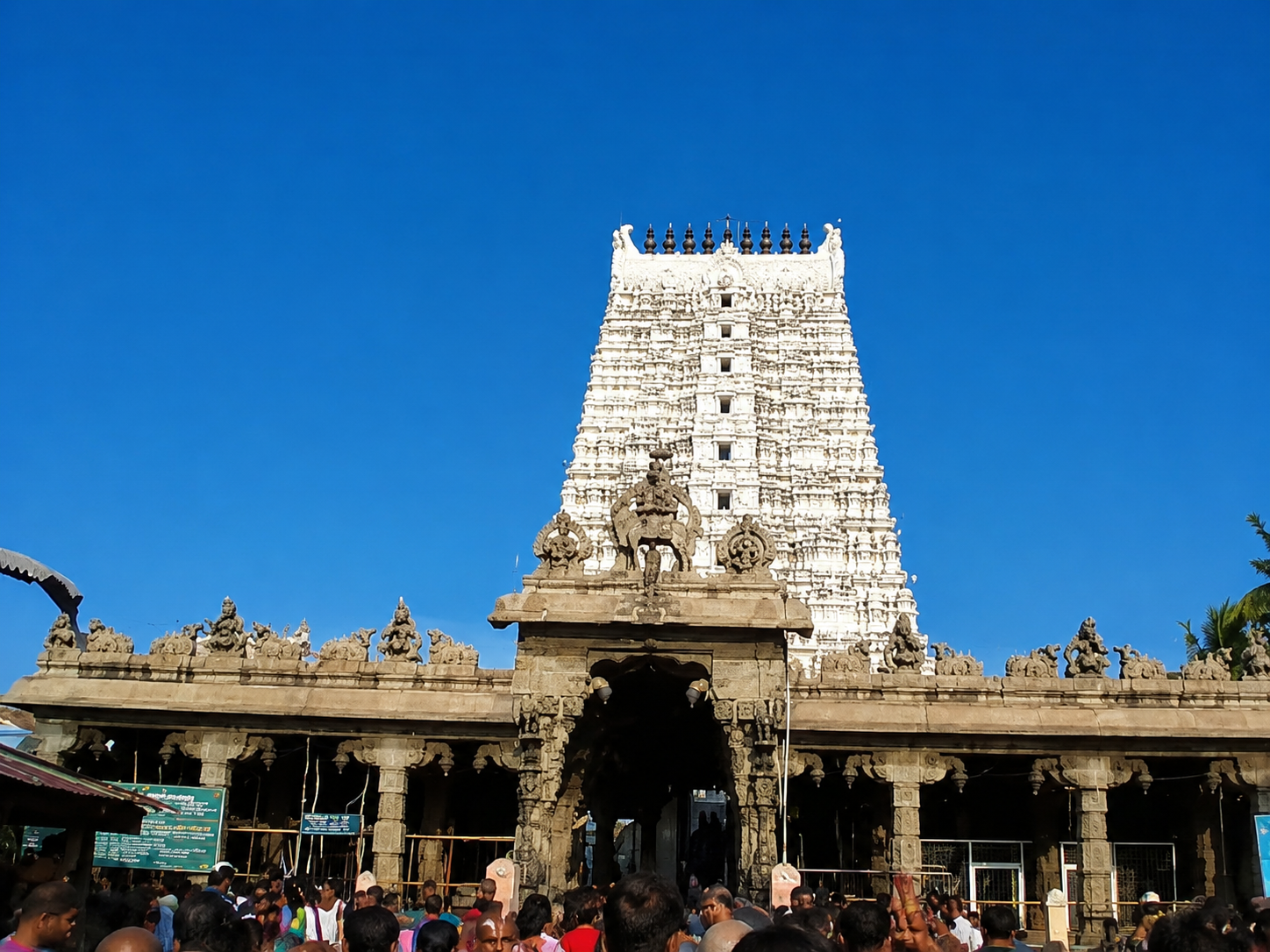
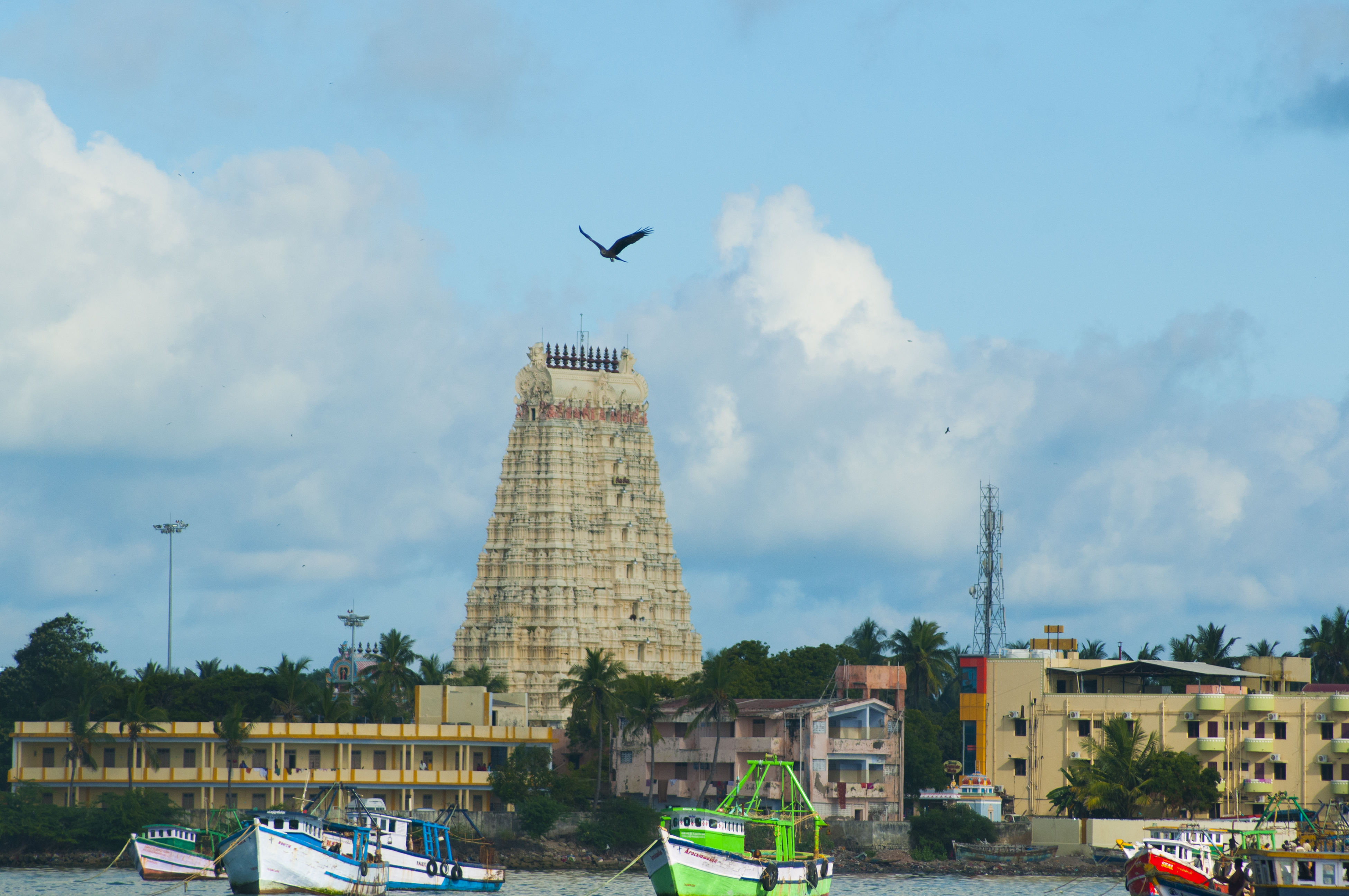
Rameswaram island,
Tamil Nadu, near the southeastern coast of India close to the sea
★Deity: Lord Shiva as Ramanathaswamy
Jyotirlinga
Ramanathaswamy Jyotirlinga Temple is one of the most sacred temples
of Lord Shiva, revered as Jyotirlinga No. 11, the eleventh among
the 12 Jyotirlingas, and stands on the island town of Rameswaram
near the southeastern coast of India close to the sea.
Also known as Ramanathaswamy Temple and Rameswaram Temple, the
shrine is famous for its long corridors, sacred water tanks, 22
Theerthams, Char Dham importance, and deep connection with the
Ramayana. It is believed that Lord Rama worshipped Shiva here
before crossing to Lanka.
Ramanathaswamy Jyotirlinga Temple mainly faces east. East-facing
temples are traditionally considered auspicious because they
symbolize purity, sunrise energy, and spiritual awakening, and
devotees enter through grand corridors leading toward the Garbha
Griha where the sacred Jyotirlinga is worshipped.
Meaning of Ramanathaswamy
Lord Shiva worshipped by Lord Rama
Rama means Lord Rama, Natha means
Lord or protector, Swamy means Lord, and Ramanathaswamy means
Lord Shiva worshipped by Lord Rama.
Rama = Lord RamaNatha = Lord /
ProtectorSwamy = LordShiva worshipped by
Rama
Temple Status
To be verified
To be verified
Crowd Expectation
To be verified
To be verified
Current crowd estimate: To be verified
Next Aarti
To be verified
To be verified
Best Darshan Window
To be verified
To be verified
Verify First
If you plan Agni Theertham and the 22 sacred wells on the same
visit, keep additional buffer time before main sanctum darshan.
Today: Split temple hours, pooja sequence and theertham access
should be checked together before you enter the queue.
Map
Map
Temple Location Snapshot
Rameswaram island, Tamil Nadu,
near the southeastern coast close to the sea
Why Ramanathaswamy Jyotirlinga Temple stands apart in the
Jyotirlinga, Char Dham, and Ramayana pilgrimage circuit
One
of the sacred 12 Jyotirlingas and clearly revered as
Jyotirlinga No. 11 and a Char Dham shrine
Located on Rameswaram island
in Tamil Nadu near the southeastern coast of India close to
the sea
Lord
Rama is believed to have
worshipped Shiva here before crossing to Lanka, giving the
shrine rare Ramayana and Rama-Shiva importance
East-facing grand corridors,
sacred water tanks, Agni Theertham, and the 22 Theerthams
shape the full darshan and purification sequence
Ramanathaswamy Jyotirlinga Temple unites sea-island pilgrimage,
sacred-water purification, Char Dham devotion, and the rare
tradition of Lord Rama worshipping Lord Shiva.
Ramanathaswamy Mythology and
Rama-Sita-Hanuman Legend
The temple's deepest sacred identity comes
from the Ramayana tradition in which Lord Rama, Sita, and Hanuman are all
connected with the establishment of the Shiva Lingam at Rameswaram.
According to legend, Rama sought
purification after defeating Ravana, Sita made the sand Lingam when
Hanuman was delayed, and both the worshipped Lingam and Hanuman's later
Lingam became central to the temple's sacred memory.
Sacred legend
According to legend, after defeating Ravana in Lanka, Lord
Rama wished to cleanse himself of the sin of killing
Ravana, who was regarded as a Brahmin. For this act of
purification, Rama desired to worship Lord Shiva at
Rameswaram.
Lord Rama requested Hanuman to bring a Shiva Lingam from the
Himalayas. When Hanuman was delayed, Goddess Sita made a
sand Lingam so that the worship could begin at the proper
time. Rama worshipped this Lingam, and it became the sacred
Ramanathaswamy Jyotirlinga worshipped in the temple
tradition.
Later, Hanuman brought the original Lingam, which is also
placed in the temple. This dual-Lingam memory gives the
shrine deep Ramayana importance and a rare Rama-Shiva
connection, making Ramanathaswamy one of the holiest Shiva
pilgrimage sites in India.
Rama's purification
Prayer after Lanka victory
Tradition remembers Lord Rama worshipping Shiva here after
the defeat of Ravana.
Sita's role
Sand Lingam at Rameswaram
When Hanuman was delayed, Sita made the sand Lingam that
became central to the shrine's sacred identity.
Hanuman's devotion
Original Lingam also honored
Hanuman's later-arriving Lingam is also remembered in the
temple, deepening the Ramayana connection.
Temple History
Ramanathaswamy Jyotirlinga Temple is
mentioned in ancient Hindu traditions, expanded over centuries through the
Pandya dynasty, Nayak dynasty, Maratha Empire, and other local patronage
layers, and remains one of the most important sea-island pilgrimage
shrines in the Char Dham circuit.
The temple's long historical identity
combines ancient sacred memory, Pandya, Nayak, Maratha, and other royal
expansion layers, and the continuing devotional importance of Rameswaram
as both a Jyotirlinga and Char Dham pilgrimage center.
Sacred timeline
The temple is mentioned in ancient Hindu traditions and has
expanded over centuries as devotion to Ramanathaswamy grew
on Rameswaram island. Its importance comes not only from
Ramayana memory, but also from its place as one of the 12
Jyotirlingas and one of the Char Dham pilgrimage sites in
India.
Major contributions are associated with the Pandya dynasty,
Nayak dynasty, and Maratha Empire in the broader historical
growth of the temple. At the same time, useful local
history on the page continues to remember Jaffna and
Sethupathi phases of expansion, showing that the complex
developed through multiple devotional and royal layers over
time.
That layered growth helps explain why Ramanathaswamy feels
like both an ancient sacred shrine and a vast pilgrimage
complex built for corridors, ritual movement, sacred-water
traditions, and continuing darshan.
Ancient tradition
Ramayana and old Hindu pilgrimage memory
The temple is rooted in ancient sacred tradition and the
continuing memory of Lord Rama's worship of Shiva.
Royal expansion
Pandya, Nayak, Maratha, Jaffna, Sethupathi
The shrine's visible form reflects centuries of layered
patronage and temple-building activity.
Pilgrimage identity
Char Dham and Jyotirlinga center
Ramanathaswamy remains one of the most important Shiva
pilgrimage destinations in India.
Temple Architecture & Design
Ramanathaswamy is best described through
Dravidian-style temple architecture, the world-famous corridor tradition,
carved stone pillars, large gopurams, and the sacred water layout shaped
by the 22 Theerthams.
The temple is especially known for its
long stone corridors, large gateway towers, intricate pillars, sacred
wells, and the grand South Indian architectural movement toward the
sanctum.
Sacred design
The complex reflects Dravidian-style temple architecture and
is widely remembered for its massive stone corridors,
large gopurams or gateway towers, and the layered
progression from temple entry toward the Garbha Griha.
Ramanathaswamy is especially celebrated for having one of
the longest temple corridors in the world. Massive stone
pillars with intricate carvings, broad passageways, and the
visual rhythm of the mandapas give the temple its grand
South Indian architectural presence.
The experience is shaped not only by the sanctum, but also
by the 22 sacred temple wells or Theerthams, wide stone
corridors leading toward the sanctum, and the constant
movement between sacred water, ritual order, and darshan.
Architecture style
Dravidian-style temple architecture
The temple stands within the grand South Indian temple
design tradition of corridors, towers, and sculpted stone.
Signature feature
World-famous corridor tradition
Long pillared corridors and massive carved stone movement
paths define the temple's visual identity.
Sacred water layout
22 wells and ritual approach
The 22 sacred Theerthams are an architectural and ritual
part of the full pilgrimage experience.
Spiritual Importance & Sacred
Features
Ramanathaswamy is revered as a temple of
purification, forgiveness, sea-island devotion, sacred-water ritual, and
the rare unity of Rama's Vishnu tradition with Shiva worship.
Worship here is believed to remove
sins, bring spiritual purity, bless devotees with peace and moksha, and
deepen faith through the sacred wells, the Rama-Shiva connection, and the
Char Dham pilgrimage tradition.
Sacred significance
Worship at Ramanathaswamy is believed to remove sins and
bring spiritual purity. Devotees come for blessings,
peace, liberation or moksha, and the grace of Lord Shiva in
a shrine where forgiveness and inner cleansing are central
themes.
The temple is also revered for the sacred water tradition
of the 22 wells or Theerthams. Many pilgrims treat the
sacred wells as part of a purification sequence that
prepares the devotee for darshan, prayer, and deeper
surrender inside the shrine.
Ramanathaswamy symbolizes devotion, the unity of Shiva and
Vishnu traditions, and divine forgiveness. The sea-island
setting, longest-corridor identity, Ramayana link, and Char
Dham importance together make it one of the holiest Shiva
pilgrimage centers in India.
22 sacred wells or
Theerthams associated with spiritual
purification
Rare temple where Lord
Rama worshipped Lord Shiva
Sea-island shrine with
one of the longest temple corridors in the
world
Char Dham pilgrimage
identity and sacred bathing tradition
Devotion, moksha,
peace, and divine forgiveness at a major
Ramayana-linked Shiva shrine
Sacred wells
22 Theerthams of purification
Each well is approached as part of a spiritual cleansing
tradition linked with darshan preparation.
Rama-Shiva connection
Lord Rama worshipped Shiva here
The shrine is revered for its rare and direct Ramayana link
between Rama devotion and Shiva worship.
Pilgrimage identity
Char Dham and moksha tradition
The temple is revered for blessings, peace, liberation,
and the wider spiritual importance of Rameswaram.
Darshan Process
A practical flow if you are planning darshan
with or without theertham bathing.
Average
total time: To be verified
Verify Before Visit
1
Reach Temple Area
Plan your approach
through Rameswaram town before entering the temple-side
zone.
2
Decide Theertham
Flow
If you want Agni
Theertham or the 22 sacred wells, build that into your
timing before joining the main darshan flow.
3
Clear Entry Checks
Footwear, item deposit,
security and current mobile rules should be confirmed before
entry.
4
Join Darshan Queue
Use the correct line
for general darshan, special entry or planned pooja
service.
5
Take Darshan or
Attend Pooja
Align your sanctum
darshan with the official pooja cycle if that matters for
your visit.
6
Exit to the Wider
Circuit
Many pilgrims continue
to Agni Theertham, Dhanushkodi or other Rameswaram
stops.
A simple travel flow for reaching Ramanathaswamy
Temple on Rameswaram island
1
Step 1
Reach the Island Gateway
Choose the most practical rail, air or road combination for Rameswaram.
Air
Madurai is the nearest major airport for most pilgrims.
Madurai-to-Rameswaram transfer is the standard air-arrival route and travel
time should be verified.
Rail
Rameswaram railway station is about 1.3 km from the temple.
The temple is widely treated as a walkable onward stop from the
station.
Road
Rameswaram bus stand is about 2 km from the temple.
Road access follows the island approach and town transfer.
Plan extra time if you are entering during a busy ritual window or festival
day.
2
Step 2
Move Through Temple-Side Access
Reaching the temple zone is usually easy, but your on-ground movement depends on what
you are combining with darshan.
Agni Theertham
Agni Theertham lies about 100 metres east of the temple.
Many pilgrims include it before or after temple entry.
22 Theerthams
Inside-temple sacred wells follow their own access window.
Plan the ritual sequence before joining the main darshan lane.
Final Entry
Temple-side queue and entry flow: To be verified.
Current local queue, footwear and entry flow should be verified.
Temple-side movement can take longer if you add ritual bathing to the same
visit.
3
Step 3
Finish the Ritual Circuit
After darshan, many visitors continue to other Rameswaram spiritual stops.
Dhanushkodi
Dhanushkodi is around 18 km from Rameswaram and reachable by road.
It is commonly treated as a wider pilgrimage extension.
Five-Faced Hanuman Temple
Often included in the broader Rameswaram spiritual circuit.
Route and current access details should be verified on the ground.
Shuttle / Assistance
Auto-rickshaw and local transfer help are commonly used.
Current availability should be verified locally.
Festival-day travel and sea-facing weather conditions can affect the island
circuit flow.
Important Travel Note:
If you want Agni Theertham, the 22 wells and main sanctum darshan on the same day,
build your visit around the official split temple schedule.
This page now
follows the shared timing sync structure. Only source-confirmed timing
values are filled in below.
Official Timings Used
Festival-day changes should
still be verified before travel.
Temple StatusTo be verifiedTo be verified
Today's
TimingTo be verified
Next AartiTo be verifiedTo be verifiedBest Darshan WindowTo be verifiedTo be verifiedCrowd ExpectationTo be verifiedTo be verifiedTemple
ClosesTo be verifiedListed daily
closing time
The official temple timing notice allows access to the 22 sacred
theerthams from 5:30 AM to 12:30 PM and again from 3:00 PM to
7:00 PM.
Tamil Nadu Tourism lists October to March as the more
comfortable season for Rameswaram temple travel.
Yes. Tamil Nadu Tourism places Agni Theertham about 100 metres
east of Ramanathaswamy Temple and describes it as the only
sacred theertham outside the temple.
Yes. The official temple service list includes special-entry
darshan, Spatikalinga darshan, Rudrabhishekam and multiple
abhishekam services. The live booking process should still be
verified locally.
The current mobile phone rule should be verified locally before
travel.
The official temple service list includes a storage room service
for items. Current access rules and what can be deposited should
still be verified locally.
The Ramanathapuram district tourism page places Rameswaram
railway station around 1.3 km from the temple.