First visit? Access, reporting, queue, Shravani Mela, and Kanwariya details: To be verified
Today: To be verified • Peak:
To be verified
Jyotirlinga No. 9
Vaidyanath Jyotirlinga Temple
Baba Baidyanath Dham, Deoghar, Jharkhand, one of the most important pilgrimage centers for Shiva devotees in eastern India
Deity: Lord Shiva as Vaidyanath / Baidyanath Jyotirlinga
Vaidyanath Jyotirlinga Temple, also known as Baidyanath Temple or
Baba Baidyanath Dham, is revered as Jyotirlinga No. 9, the ninth
among the 12 Jyotirlingas of Lord Shiva, and stands in Deoghar,
Jharkhand.
The temple is famous for healing significance, the Ravana legend,
Shravani Mela, Kanwariya pilgrimage, continuous Jalabhishek, and
the faith that Shiva here relieves suffering, illness, and
negative energies.
Timings, access rules, route conditions, crowd guidance, booking
details, Shravani Mela flow, and Kanwariya arrangements: To be
verified.
Meaning of Vaidyanath
Lord Shiva as the Divine Healer
Vaidya means doctor or healer,
Nath means Lord, and Vaidyanath means Lord Shiva as the Divine
Healer.
Vaidya = HealerNath = LordDivine Healer
Temple Status
To be verified
Temple opening status:
To be verified
Crowd Expectation
To be verified
Crowd guidance: To be
verified
Queue flow and peak periods: To be verified
Next Aarti
To be verified
Aarti details: To be
verified
Best Darshan Window
To be verified
Preferred darshan window:
To be verified
Recommended
Route flow, darshan timing, access pattern, Shravani Mela
movement, and Kanwariya pilgrimage details: To be verified.
Understanding the spiritual importance of Vaidyanath / Baidyanath
One
of the 12 Jyotirlingas of Lord Shiva and revered as
Jyotirlinga No. 9
Located in Deoghar,
Jharkhand, one of the most important Shiva pilgrimage
centers in eastern India
Also known as Baidyanath
Temple and Baba Baidyanath Dham
Famous
for spiritual healing power, Ravana legend, Shravani Mela,
and continuous Jalabhishek
Mainly
east-facing and deeply associated with Kanwariya
pilgrimage from Sultanganj to Deoghar
Baidyanath Jyotirlinga Temple, also known as Vaidyanath Temple or
Baba Baidyanath Dham, is one of the sacred 12 Jyotirlingas of Lord
Shiva and is regarded as the ninth Jyotirlinga. It is located in
Deoghar, Jharkhand, and is one of the most important pilgrimage
centers for Shiva devotees in eastern India.
The temple is famous for spiritual healing power, Ravana's legend,
Shravani Mela pilgrimage, and continuous Jalabhishek. Devotees
believe worship here helps cure suffering, illness, and negative
energies. The temple mainly faces east, and east-facing temples are
traditionally considered auspicious because they symbolize purity,
divine light, and positive spiritual energy.
Vaidyanath's sacred mythology is tied to
Ravana's intense tapasya, Shiva's healing compassion, and the Lingam
becoming permanently fixed at Deoghar as Baba Baidyanath Dham.
According to tradition, Shiva healed
Ravana like a divine physician, agreed to accompany him as a Jyotirlinga,
and then became permanently established at Deoghar.
Sacred legend
According to legend, Ravana performed severe penance to
please Lord Shiva and even offered his heads in devotion.
Pleased by Ravana's intense tapasya, Shiva appeared and
healed him like a divine physician or Vaidya, which is why
Shiva became known here as Vaidyanath.
Ravana then requested Shiva to come with him to Lanka in
the form of a Jyotirlinga. Shiva agreed, but warned that
the Lingam should never be placed on the ground during the
journey. The gods became worried about Ravana's growing
powers and created a situation in which Ravana temporarily
handed the Lingam to a cowherd boy.
The cowherd boy placed the Lingam on the ground at
Deoghar. The Lingam became permanently fixed there, and the
place became famous as Baba Baidyanath Dham, one of the
holiest Shiva pilgrimage sites in India.
Ravana's tapasya
Heads offered in devotion
Tradition remembers Ravana's penance as one of the most
intense acts of Shiva devotion.
Healing form of Shiva
Vaidyanath as Divine Healer
Shiva healed Ravana like a divine physician and became
known here as Vaidyanath.
Deoghar identity
Lingam fixed at Deoghar
The cowherd-boy episode made the shrine permanently rooted
at Baba Baidyanath Dham.
Temple History
Vaidyanath has ancient origins and remains one
of the most important Shaiva pilgrimage centers in Deoghar, with a history
tied to the Shiva Purana, old pilgrimage traditions, and the growth of
Kanwar devotion in eastern India.
The temple is remembered through the
Shiva Purana, ancient pilgrimage traditions, long devotional continuity,
and Deoghar's rise as a major center of Shaivism and Kanwar pilgrimage.
Sacred timeline
The temple has ancient origins and is mentioned in the
Shiva Purana and old pilgrimage traditions. Over centuries,
Vaidyanath remained closely tied to the sacred geography of
Deoghar and to the long continuity of Shiva worship in
eastern India.
Many Hindu rulers and devotees supported the temple's
maintenance and religious activities over time. This
continuity helped Deoghar become one of the major centers
of Shaivism and Kanwar pilgrimage traditions in India.
The shrine remains especially important because of the
Jyotirlinga identity, the continuing flow of devotees, and
the strong ritual rhythm seen during Shravani Mela. The
present complex is best understood as an ancient sacred
center with enduring devotional continuity.
Ancient origins
Shiva Purana tradition
The temple is linked with the Shiva Purana and ancient
pilgrimage memory.
Religious continuity
Shaivism and Deoghar devotion
Deoghar developed into one of the major centers of Shiva
worship in eastern India.
Pilgrimage identity
Kanwar and Shravani tradition
The shrine remains central to Kanwariya devotion and the
larger Shravani pilgrimage cycle.
Temple Architecture & Design
Vaidyanath is best described through
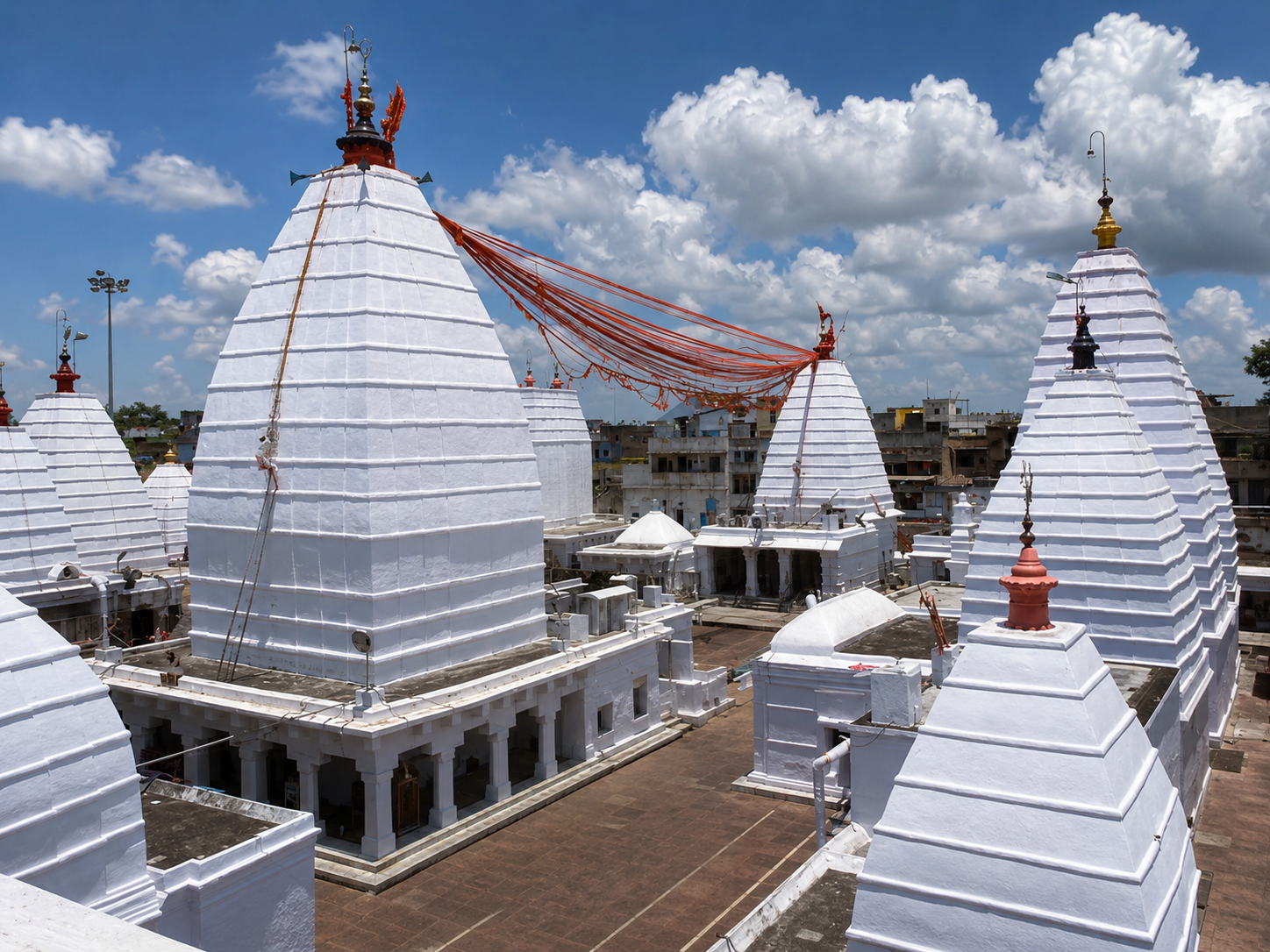
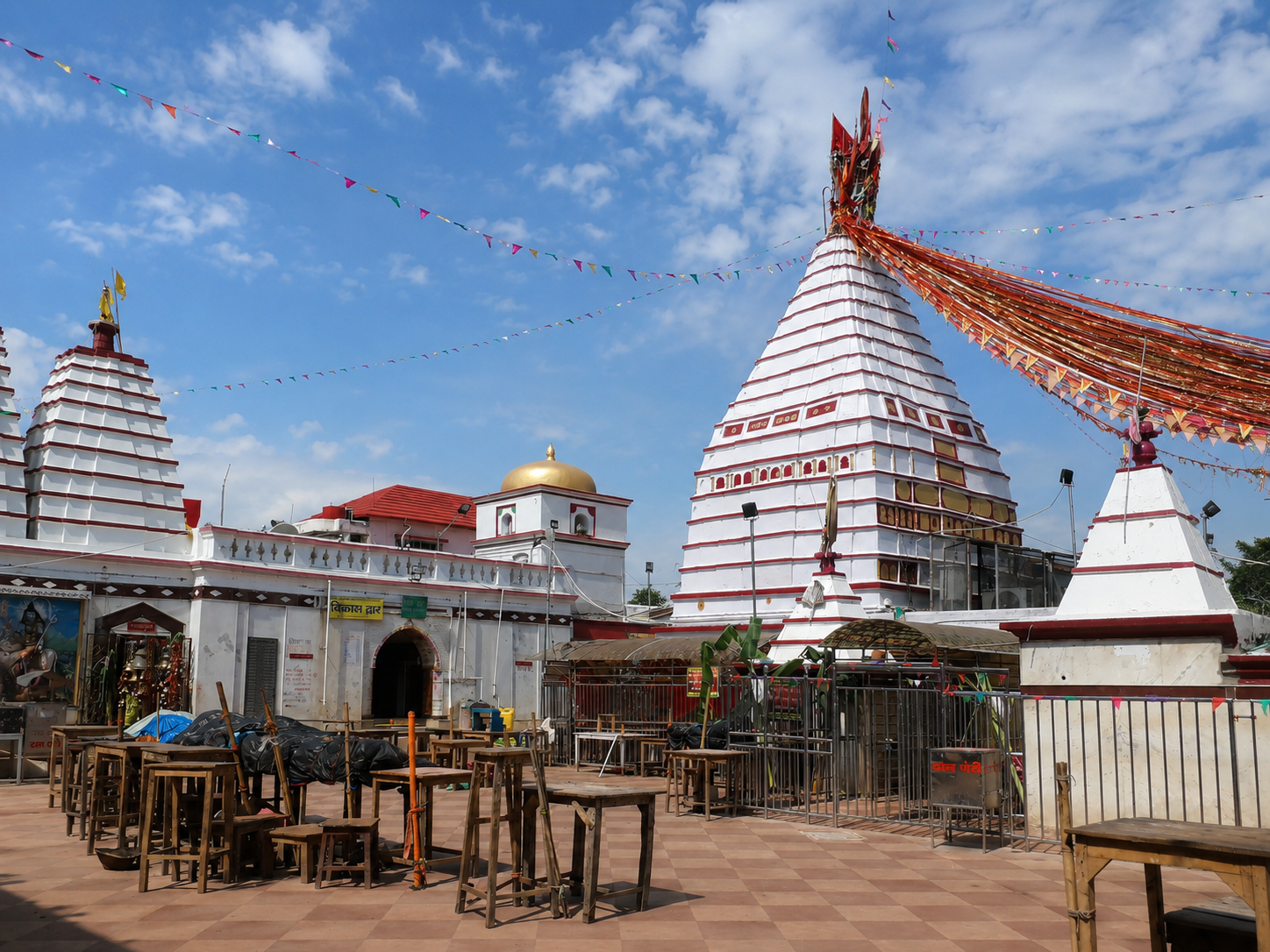
traditional North Indian temple architecture, a tall white shikhara, a
sacred temple courtyard, and a surrounding cluster of shrines that support
the living rhythm of worship in Deoghar.
The complex is known for its white
temple shikhara, surrounding shrines, ancient pathways, ritual water
offerings, and the living devotional flow of Baba Baidyanath Dham.
Sacred design
The shrine reflects traditional North Indian temple
architecture and is visually marked by a tall white temple
shikhara rising over the main sanctum. The sacred temple
courtyard, surrounding shrines, and ritual pathways shape
how pilgrims experience the site.
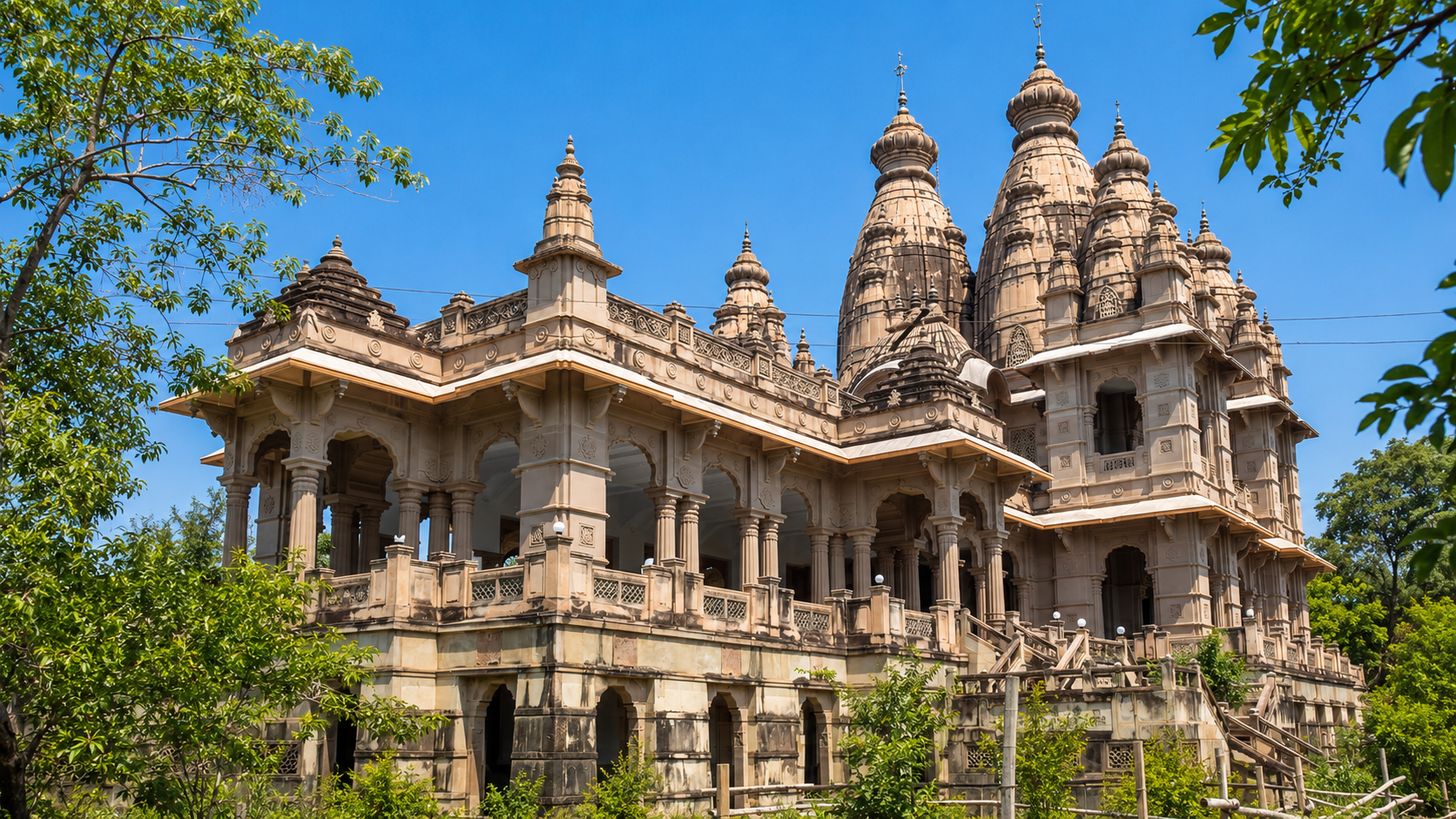
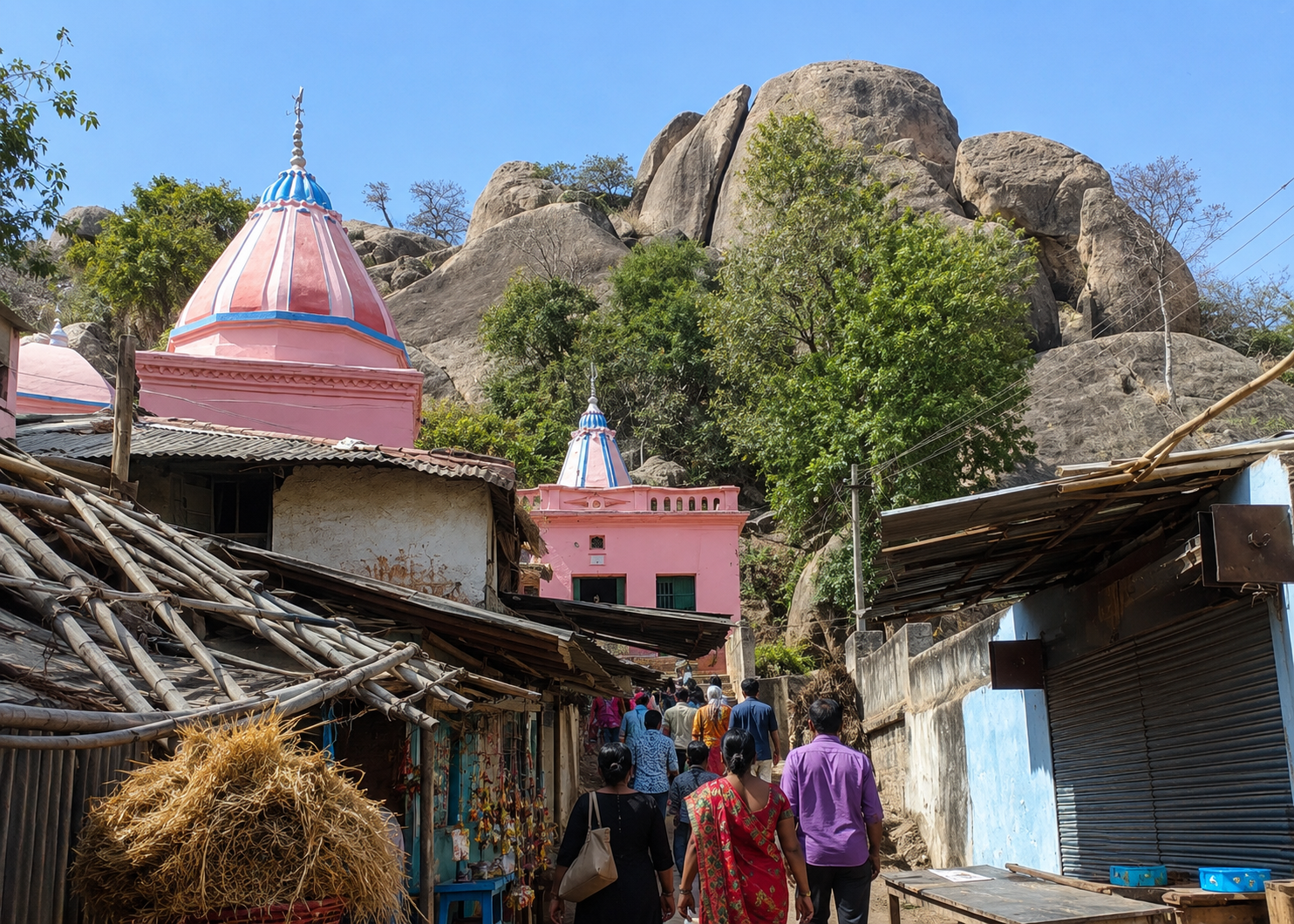
The main temple complex contains several smaller temples
dedicated to various Hindu deities. Ancient stone
structures, walking paths, and clustered devotional spaces
make the precinct feel like a complete pilgrimage complex
rather than a single isolated shrine.
Holy water offerings from pilgrims, milk abhishek, Bilva
leaf worship, and the continuing movement of Jalabhishek
devotees are also part of the temple's living architectural
atmosphere.
Architecture style
Traditional North Indian temple architecture
The shrine is defined by a tall white shikhara and a sacred
temple courtyard.
Temple complex
Cluster of surrounding shrines
Several smaller temples and ancient pathways shape the
wider Baba Baidyanath Dham precinct.
Ritual atmosphere
Jalabhishek and sacred offerings
Holy water, milk, and Bilva leaf offerings remain integral
to the living temple experience.
Spiritual Importance & Sacred Features
Baidyanath is revered as a healing form of
Shiva, a place of compassion and purification, and one of the most
important eastern India pilgrimage centers for continuous Jalabhishek and
Shravani devotion.
Worship at Baidyanath is believed to
cure illnesses, remove suffering, grant peace, and bless devotees who come
with faith, health-related prayers, and offerings of sacred water, milk,
and Bilva leaves.
Spiritual meaning
Worship at Baidyanath Jyotirlinga is believed to cure
illnesses, remove suffering, and grant peace. Devotees pray
here for health, protection, spiritual purification, and
the fulfillment of wishes, and the shrine is deeply
associated with devotion, healing, faith, and Shiva's
compassion.
The temple is also revered for its special pilgrimage
features. Shravani Mela draws large numbers of Kanwariya
pilgrims, and during this sacred period devotees carry
Ganga water from Sultanganj to Deoghar for offering to Baba
Baidyanath. This tradition is one of the defining
devotional identities of the shrine.
Continuous Jalabhishek, holy water offerings, milk,
Bilva leaves, Ravana's legend, and the healing form of
Shiva together make Vaidyanath one of the most visited and
spiritually significant Shiva temples in eastern India.
Healing form of Shiva and Lord of divine compassion
Ravana connection and Baba Baidyanath Dham identity
Shravani Mela and Kanwariya pilgrims carrying sacred Ganga water from Sultanganj to Deoghar
Continuous Jalabhishek with holy water, milk, and Bilva leaf offerings
One of the most visited Shiva temples and a major eastern India pilgrimage center
Healing significance
Health, peace and protection
Devotees come seeking relief from illness, suffering, fear,
and negative energies.
Pilgrimage identity
Shravani Mela and Kanwariya Yatra
Ganga water carried from Sultanganj to Deoghar is a defining
act of Baba Baidyanath devotion.
Ritual offerings
Jalabhishek, milk and Bilva
Continuous abhishek offerings remain central to the shrine's
living ritual tradition.
Darshan Process
A quick visual flow from entry point to
exit.
Average total time: To be
verified
Verify Before Visit
1
Reach Temple Area
Final drop point and
temple approach details: To be verified.
2
Clear Security
Phone, bag and
restricted-item rules: To be verified.
3
Join Queue Lane
Queue format, darshan
lane and access pattern: To be verified.
4
Move Final Stretch
Internal access path,
batch movement and reporting steps: To be verified.
5
Take Darshan
Darshan duration and
inner-entry flow: To be verified.
6
Follow Exit Flow
Exit route, re-entry
rules and nearby movement guidance: To be verified.
Check latest
timing, aarti access, crowd guidance, route access and Shravan mela
details before visit.
Verify Before Visit
Temple timing, aarti
schedule, access and Shravan mela details: To be verified.
Temple StatusTo be verifiedDaily schedule and
ritual access: To be verified.
Current
GuidanceTo be verified
Next AartiTo be verifiedTo be verifiedBest Darshan WindowTo be verifiedTo be verifiedCrowd ExpectationTo be verifiedTo be verifiedTemple
ClosesTo be verifiedTo be verified
Daily
Entry
Temple Timings
Temple OpensTo be verified
Best Darshan WindowTo be verified
General DarshanTo be verified
Most
sensitive ritual windowTo be verified
Temple
ClosesTo be verified
Main
Rituals
Aarti Schedule
Kancha
JalNextTo be verified
Day
ClosureNextTo be verified
Evening
ReopenNextTo be verified
Shringar
PujaNextTo be verified
Temple ClosesNextTo be verified
Temple timing, aarti
schedule, access, Shravani Mela, and Kanwariya details: To be verified.
For most devotees, Baidyanath planning
is about both season and route timing. Daily darshan timing, crowd
pattern, access, and Shravani Mela details are To be verified.
Most balanced season
October to March
Cooler temperatures make it easier to handle local access,
transfers and longer devotional days around the temple
precinct.
Spiritually intense period
Shravani Mela and major Shiva festivals
Festival-period crowd, route handling and mela
movement details: To be verified.
Best daily window
To be verified
Preferred daily darshan and queue window: To be
verified.
Nearby Temples & Spiritual Circuit
Important pilgrimage stops to visit around
Vaidyanath Jyotirlinga Temple and the wider Deoghar spiritual circuit
Basukinath Temple
To be verified
Frequently linked
with Baidyanath pilgrimage planning. Exact onward
access and travel sequence: To be verified.
Traditional offerings at Baidyanath
are simple, devotional and closely tied to Shiva worship, with puja
essentials and sacred rituals usually arranged through trusted local
vendors or approved temple channels. For prasad availability, check
the temple counter on arrival.
Bel patra, flowers, milk or
abhishek items and Rudrabhishek remain the most familiar offerings for
devotees visiting Baidyanath, while packaged prasad should be checked
at the temple counter.
Flowers
Fresh flowers and simple puja thali items are among
the most common devotional offerings for Lord Shiva
and are easily available through trusted local
vendors near the temple approach.
Bel Patra
Bel patra remains one of the most symbolically
important
offerings in Shiva worship and is often part of
simple,
focused puja at Baidyanath.
Milk / Abhishek Items
Milk-based abhishek offerings are widely associated
with Shiva worship. Devotees should follow current
temple rules and approved puja procedures before
bringing ritual items inside.
Rudrabhishek / Abhishek
Rudrabhishek is one of the most sought-after temple
rituals for devotees seeking a deeper spiritual
offering experience at Baidyanath. Use official
temple channel guidance for booking and reporting.
Offering Preview
Active offering
Flowers
Active offering
Bel Patra
Active offering
Milk / Abhishek Items
Active offering
Rudrabhishek / Abhishek
Before You Visit (Important Tips)
Short reminders that help avoid confusion
and keep darshan smoother.
Avoid These Mistakes
Do not
assume current aarti or darshan timing without
verifying the latest temple guidance.
Do not
assume mobile phone and large-bag rules without
checking: To be
verified.
Do not
assume aarti timing, crowd level and reporting cut-off:
To be
verified.
Helpful Tips for Smooth Darshan
Reach
temple approach, crowd pattern and calmer darshan
window: To be verified.
Keep
booking confirmation, ID and entry-check
requirements: To be verified.
Verify
current aarti booking and entry rules: To be
verified.
Before You Visit
A little planning before you leave for the
temple usually makes the
darshan experience calmer, especially on busier aarti days.
Arrival checklist
Prepare these basics before entering the temple zone
Security
checks, deposit needs and restricted-item handling:
To be verified.
Latest
darshan, aarti and puja timing: To be
verified.
Temple-side
access, local route use and local movement:
To be verified.
Festival-day
crowd pattern and arrival buffer: To be
verified.
Queue
movement, checkpoint timing and the final walking
approach: To be verified.
Mobile
phone, bag and electronics rules: To be
verified.
Booking
confirmation, ID requirement and ritual-slot
verification process: To be verified.
Planning note
Plan for the full arrival flow, not just temple
timings
Local access, security checks and queue
pauses: To be verified.
Dress Code & Allowed Items
Simple, respectful choices usually make the
visit smoother than trying
to manage extra items near a tightly monitored temple entry.
Modest clothing, light items and
simple offerings usually make entry, walking and security checks much
easier.
Clothing
Dress modestly and comfortably
Temple-appropriate clothing is the easiest choice for
darshan
lines, walking access and longer devotional visits.
Modest clothing
is
generally the safest option.
Choose easy,
comfortable clothing for walking and
waiting.
Restricted items
Check the current rules before you carry extras
Bag, phone, electronics and deposit rules can vary by
crowd
control setup, temple guidance and security
enforcement.
Confirm the
latest rules for bags, phones, electronics and
leather items.
Security and
deposit procedures may change with the
situation.
Offerings
Keep puja items simple and temple-appropriate
Simple offerings are easier to manage and more likely to
fit
current entry expectations near the temple complex.
Keep offerings
modest,
clean and appropriate for Shiva
worship.
Confirm
local
guidance if you plan to carry special ritual
items.
Accommodation Near Temple
Where you stay affects how easy an early
darshan day feels, especially
when local access, festival traffic and transfers become part of the
plan.
Staying near the temple precinct or
a practical transfer point usually makes early darshan planning much
smoother than depending on long city transfers.
Best area to stay
Choose a base that supports your darshan timing
If temple access is the priority, stay in an area that
keeps
the morning approach manageable instead of adding a long
transfer before the queue.
Temple precinct or Deoghar temple-side area
Useful for walkable temple and city access
Staying near the temple side or nearby Deoghar temple-side
area can make it easier to combine darshan, local
movement and nearby temple visits in one day.
Near railway station
Practical for shorter trips and easier transfers
This area can work better for visitors arriving by train,
carrying luggage or prioritizing simpler onward travel
over
walkable town-center ambience.
Budget and comfort
Balance price, access and early-start convenience
Budget stays can work well if access is clear, while
comfort
stays are often worth considering when your visit
depends on
rest, early reporting or family travel.
Convenience note
Town-center stays can be atmospheric but slower for arrival
Staying too deep inside older town lanes may feel immersive,
but it can complicate luggage movement, auto drop-offs and very
early temple starts.
Official Info & Booking Help
Use official confirmation for ritual
planning whenever your visit depends
on a specific booking, reporting time or access rule.
Use official sources first whenever
your visit depends on a puja slot, reporting window or paid ritual
booking.
Where to confirm
Start with official sources
For puja access, timing changes and reporting
instructions,
official guidance should be your first reference point.
Temple sourceCheck official
temple
source
Booking accessConfirm from
official booking portal
Special pujasUse official
helpdesk
guidance for ritual-specific support
Before you depend on a
booking
Verify the process before you travel
Reporting windows, entry rules and ritual availability
can
shift, so final confirmation matters even after you plan
the
trip.
Ritual processConfirm the
latest
booking method from the official source
Reporting timeCheck the current
reporting window before reaching the
temple
Third-party cautionAvoid
relying
only on unverified third-party booking
claims
Trust reminder
Use verified guidance when the visit depends on a paid
ritual
If your darshan day depends on a specific aarti or puja slot,
re-check official instructions shortly before travel rather than
depending only on older summaries or unofficial listings.
Temple Location
Use this location snapshot for last-mile
planning around the temple precinct, the Deoghar approach and your
arrival point in the city.
CityDeoghar
StateJharkhand
LandmarkBaba Baidyanath Dham, Deoghar
Railway StationJasidih Junction / Deoghar route
AirportDeoghar Airport
AccessTo be verified.
Live Darshan Preview
Internal live accessOpen Divine Temple Guide live darshan for the active viewing
route.
Live darshan access
Live Temple Darshan
This sidebar card keeps live darshan discoverable on the temple page
while routing viewing access through the Divine Temple Guide live section.
Use the internal
live-darshan page for the next step.
Daily darshan timing, opening or closing schedule and ritual
windows are To be verified.
October to March is usually the more comfortable season for
Baidyanath visits, but the preferred daily darshan and
Shravan mela handling details are To be verified.
Devotees should wear modest, temple-appropriate clothing.
Comfortable footwear helps before the final deposit point,
and simple traditional or respectful attire is the safest
choice for darshan and aarti visits.
Entry rules, phone restrictions, bag checks, route access and
current security process are To be verified.
Aarti availability, access procedure and booking requirement
are To be verified.
Mobile phone and electronic-item rules are To be verified.
Locker or deposit facility availability is To be verified.
Average darshan duration is To be verified.
Online pooja booking availability and current booking rules are
To be verified.